Protein–protein interactions, PPIs, govern the vast majority of cellular processes, and their dysregulation underlies many diseases including cancer. The p53/hDM2 axis is a well-validated oncology target: hDM2 overexpression in tumor cells silences the p53 tumor suppressor, driving unchecked proliferation. Yet inhibiting this PPI with small molecules remains difficult because the binding interface is broad and shallow, without well-defined pockets. Peptide-based ligands that mimic the native binding partner offer an alternative strategy, and α-helical scaffolds in particular have attracted attention because many PPI hot spots are presented on a helix face. A structurally well-defined scaffold that can be rationally decorated with recognition residues would allow systematic optimization of both affinity and selectivity.
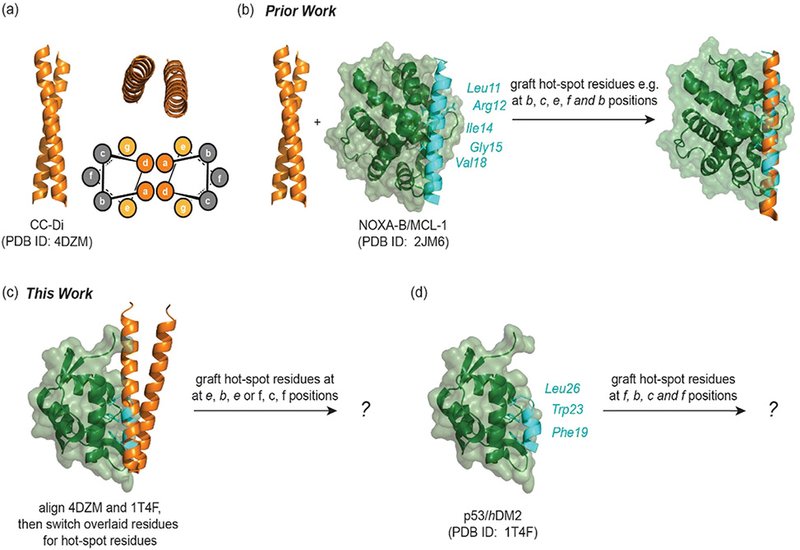
Researchers in the Wilson Group at the University of Birmingham, the Itzhaki Group at the University of Cambridge, and the Woolfson Group at the University of Bristol, published in RSC Chemical Biology, extending a coiled-coil grafting platform previously applied to the NOXA-B/MCL-1 PPI to the p53/hDM2 system. The team used the de novo parallel homodimeric coiled coil CC-Di as a template, grafting p53 hot-spot residues onto its solvent-exposed heptad positions. Two design strategies were pursued: structural alignment of CC-Di with the p53/hDM2 crystal structure to identify overlapping register positions, and a more targeted approach that placed the p53 hot-spot triad F19, W23, and L26 at the f, b, c, and f positions across two central heptads. AlphaFold3 was used to model peptide–hDM2 complexes and guide design choices, while solid-phase synthesis, circular dichroism, fluorescence anisotropy, and native mass spectrometry provided experimental validation.
Circular dichroism confirmed that the grafted peptides retained α-helical character, though scaffolds bearing more extensive substitutions showed reduced helical content and lower thermal stability compared to the parent CC-Di, which has a melting temperature of 75 °C. Fluorescence anisotropy competition assays against a labeled p53 tracer peptide showed that five of the six designs, CC-Di-p53-2 through CC-Di-p53-6, inhibited the p53/hDM2 interaction in the low-to-sub-micromolar range. The most extensively grafted variant, CC-Di-p53-6, carrying the FL.YW.LL recognition sequence, achieved an IC50 of 240 ± 3 nM. Direct binding measurements by fluorescence anisotropy confirmed affinities at the single-digit micromolar level or better across the series, with CC-Di-p53-5 binding hDM2 with a KD of 0.35 ± 0.05 μM and CC-Di-p53-6 with a KD of 0.07 ± 0.01 μM, comparable to the tracer peptide FAM-Ahx-p53-Opt at 0.08 ± 0.01 μM.
Selectivity experiments demonstrated that none of the designed peptides bound to BCL-xL or SPOP, two structurally distinct proteins, indicating that hDM2 recognition is specific to the grafted hot-spot residues rather than a general scaffold effect. Native mass spectrometry further illuminated stoichiometry: CC-Di-p53-6 formed a 1:1 complex with hDM2, consistent with its lower coiled-coil stability and suggesting that increased scaffold decoration promotes monomer release for target engagement. Designs grafted at the f, b, c, and f heptad positions, CC-Di-p53-4 and CC-Di-p53-5, showed access to multiple stoichiometries including 2:1 and 2:2 peptide-to-protein complexes, in agreement with AlphaFold3 predictions.
This work establishes that the CC-Di scaffold can be adapted across distinct helix-mediated PPI targets beyond NOXA-B/MCL-1, with selectivity tunable by choice of grafted residue. The results also reveal a functional trade-off: greater hot-spot grafting onto the scaffold increases inhibitory potency but erodes coiled-coil stability, shifting the preferred binding mode from a dimeric assembly toward a monomeric peptide engaging one protein copy. The authors identify aqueous solubility as a remaining challenge, suggesting surface-charge optimization or a solubility tag as near-term improvements. The platform provides a systematic framework for designing parallel coiled-coil-based PPI inhibitors and a structural rationale for tuning assembly state alongside binding affinity in future campaigns.